
Logistics · Forecasting · Optimization
Rail Container Loading Optimization
An educational case study on how forecasting and optimization can support rail container loading decisions under capacity, service, revenue, and operational constraints.
Decision
Which containers should be loaded?
Constraint
How should limited train capacity be used?
Trade-off
Revenue, utilization, and SLA performance.
Affiliation

Project Context
Rail container loading is a recurring planning problem. Before a train departs, planners need to decide which containers should be loaded, how those containers should be assigned to wagons, and whether the available capacity is being used effectively.
The decision is not only about fitting containers into wagons. A good loading plan also needs to consider commercial value, service commitments, destination requirements, operational feasibility, and the risk of leaving containers behind.
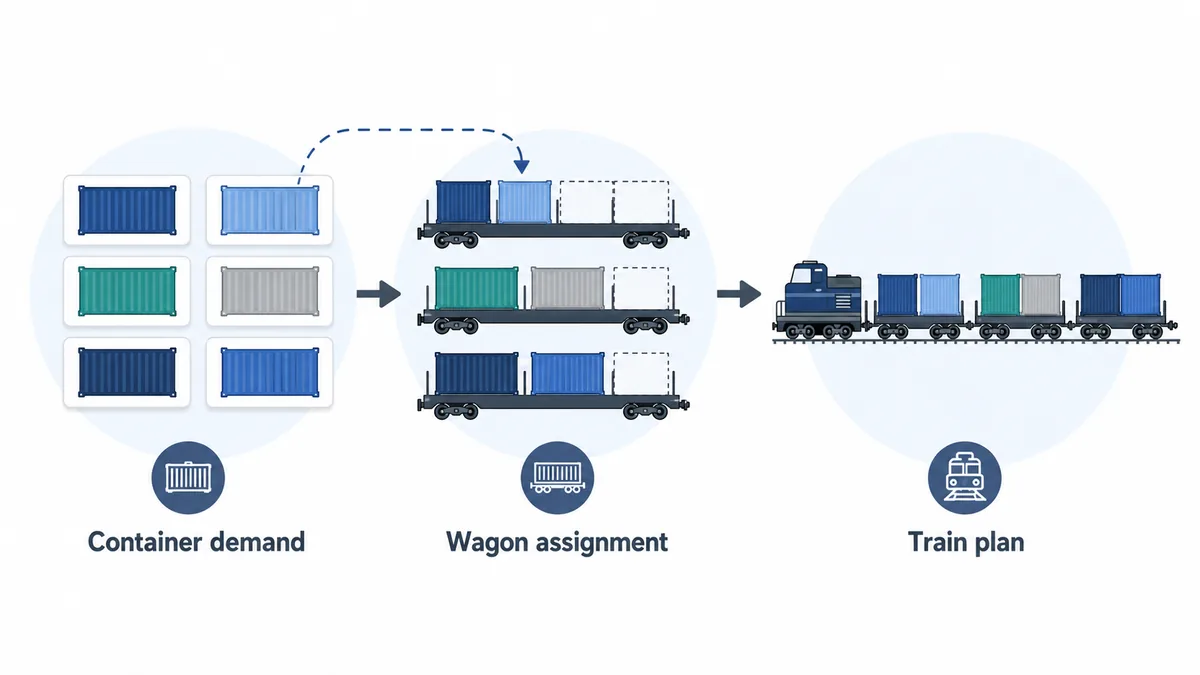
Illustrative workflow diagram.
Why the Problem Is Difficult
Manual planning can work when the problem is small. The difficulty increases when many containers, wagons, rules, and business priorities need to be evaluated at the same time.
Physical constraints
Containers differ by length and weight, while wagons and trains have limited capacity.
Operational rules
Loading plans must respect wagon compatibility, destination requirements, and safety rules.
Commercial priorities
Some containers may carry higher value or stronger service commitments than others.
Planning uncertainty
Demand visibility can change as bookings, arrivals, disruptions, and backlogs evolve.
Forecasting and Optimization Approach
Forecasting and optimization solve different parts of the same planning challenge. Forecasting improves visibility of upcoming container demand, while optimization converts that visibility into a feasible loading decision.
This distinction is important. Forecasting helps answer what demand may arrive. Optimization helps answer what should be done with the available demand and capacity.
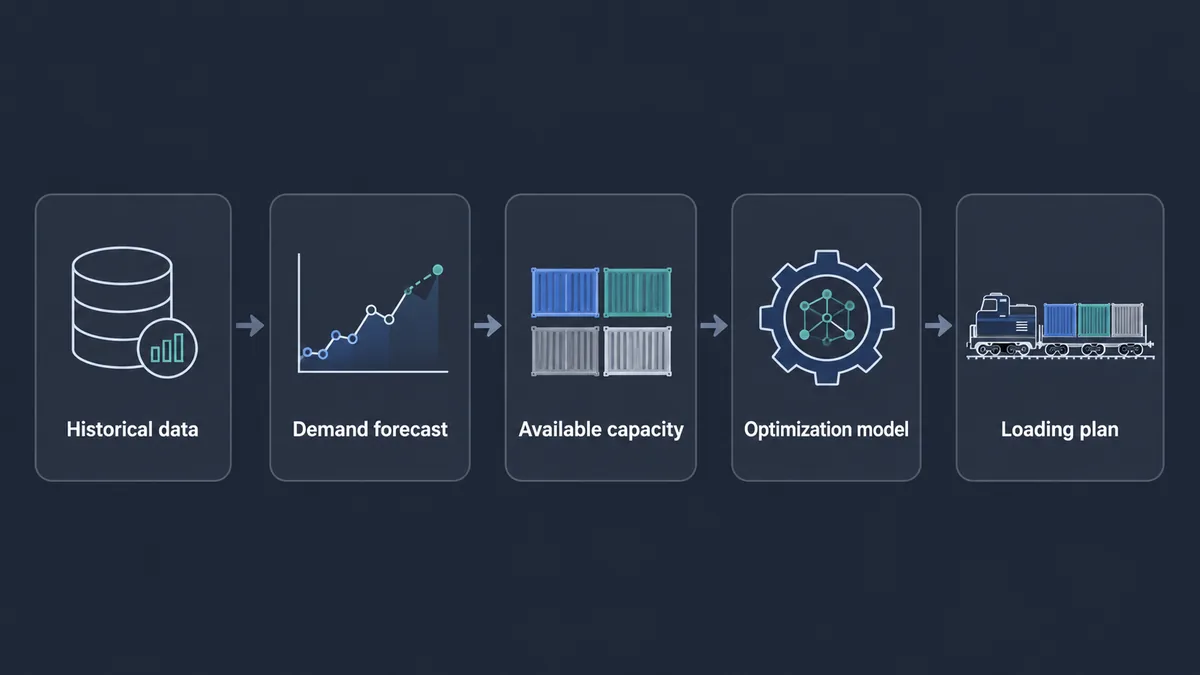
Illustrative planning pipeline.
Optimization Model Structure
At the technical level, the loading problem can be structured as a constrained optimization model. The model evaluates feasible container and wagon combinations, then selects a loading plan that improves the objective while respecting operational rules.
Inputs
- • Container attributes
- • Wagon capacity
- • Train capacity
- • Priority and SLA data
- • Revenue or yield estimates
Decision
- • Which containers to load
- • Which wagons to use
- • How containers are assigned to wagons
Constraints
- • Weight limits
- • Length limits
- • Compatibility rules
- • Service and priority rules
- • Operational feasibility
Outputs
- • Loading plan
- • Wagon assignment
- • Unassigned containers
- • Utilization metrics
- • Scenario comparison
Objective
The objective can be designed to improve train yield while balancing loading volume, capacity utilization, customer priority, and service performance. The exact weighting depends on the planning policy being tested.
Scenario Analysis and Decision Support
The model is useful not only because it produces one loading plan, but because it allows planners to compare alternatives. Different planning policies can be tested before they are applied in real operations.
Manual vs optimized planning
Compare existing planning results against model-generated loading plans.
Priority rule testing
Evaluate how different service or commercial priorities change the final plan.
Residual capacity analysis
Identify unused wagon or train capacity and estimate whether more demand could be served.
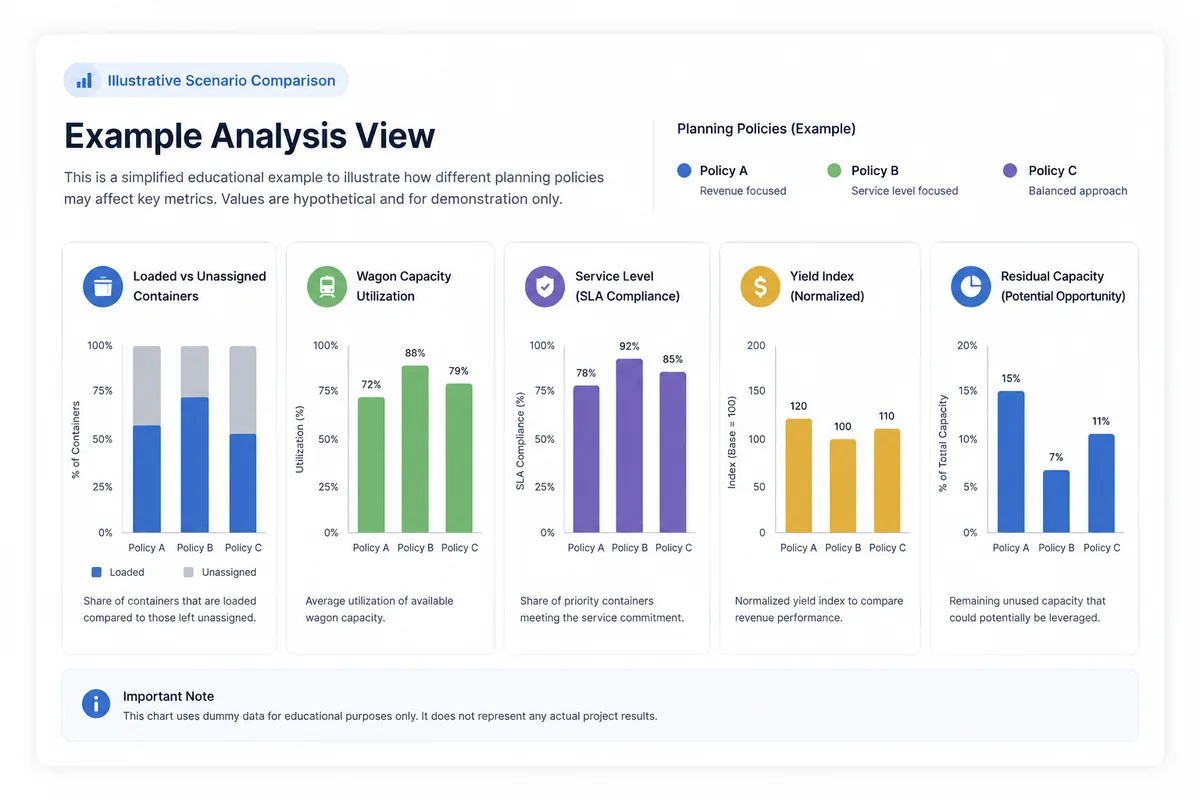
Illustrative scenario comparison using dummy values. Not based on project data.
Closing Insight
Rail loading optimization shows how a complex operational process can be reframed as a structured decision problem. By combining demand visibility, mathematical optimization, and scenario analysis, planners can move from reactive planning toward more consistent and commercially aware capacity decisions.